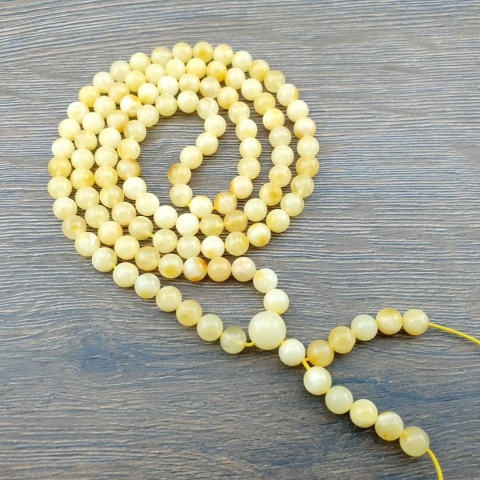
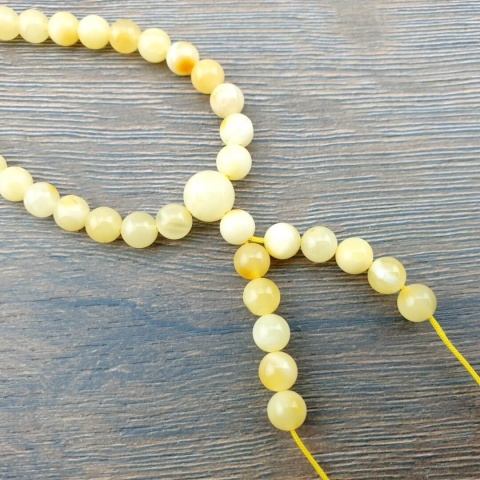
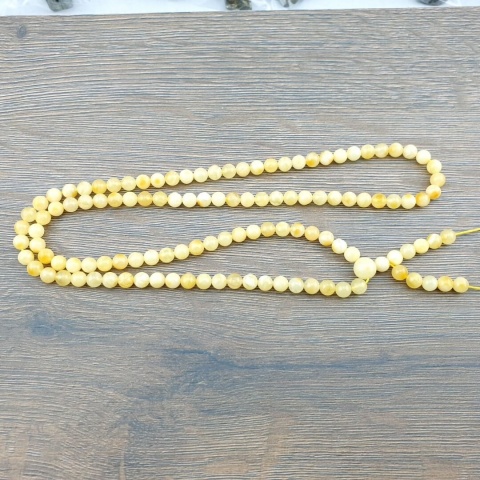
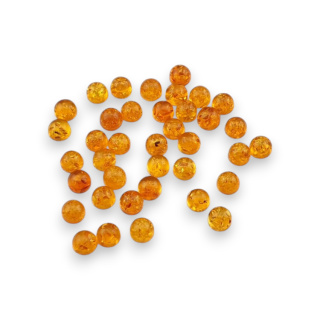
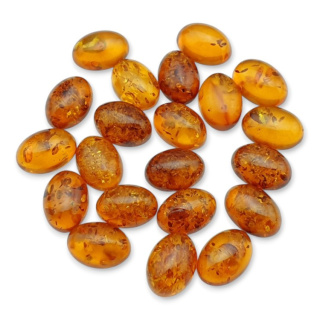
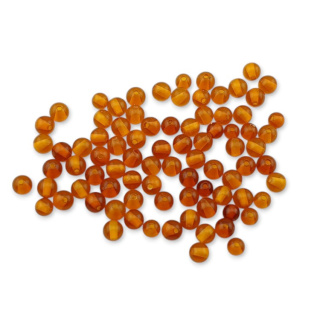
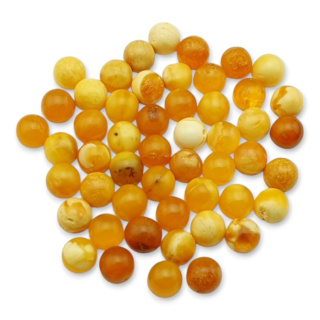
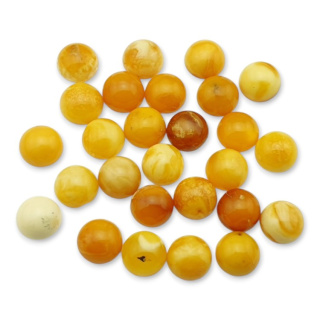
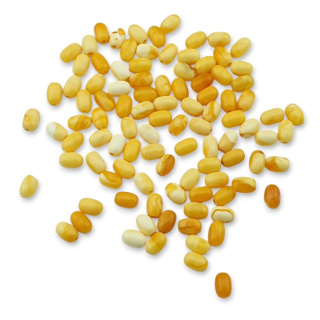
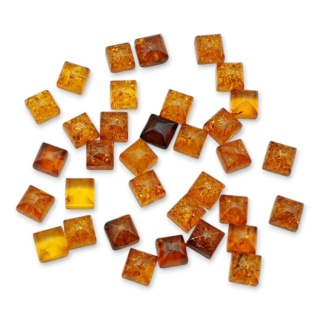
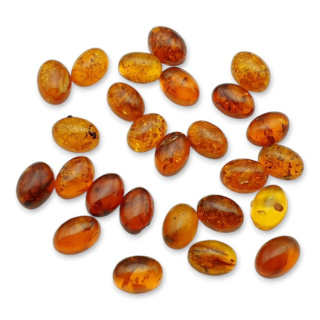
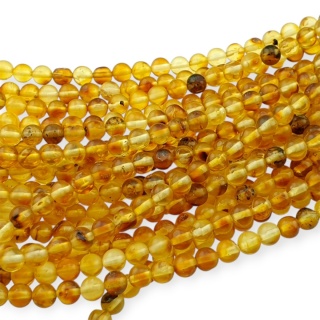
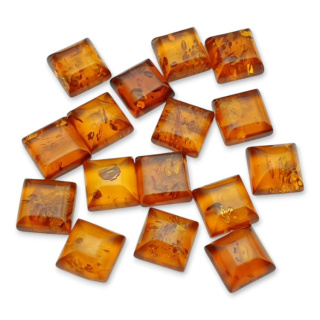
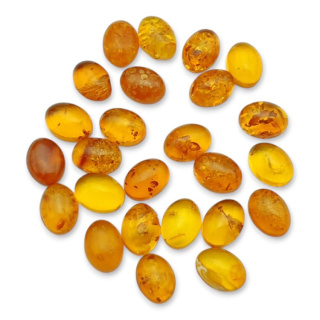
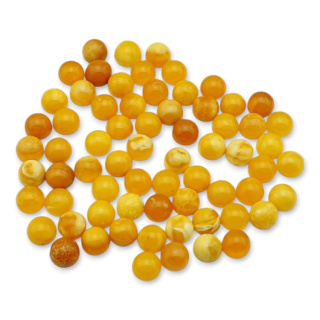
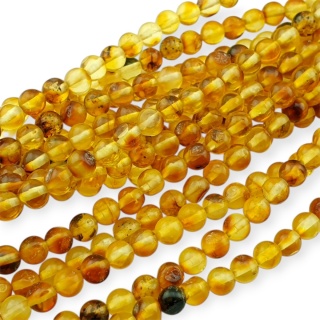
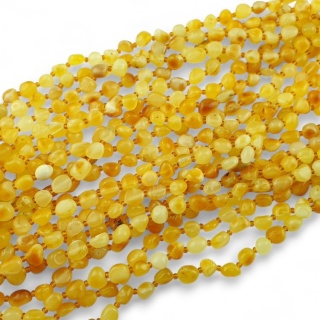
Mala 108 made of natural Baltic amber - 5.5 mm beads
Mala 108 - a traditional prayer or meditation bead consisting of 108 beads made of natural Baltic amber. It originates from the traditions of Hinduism and Buddhism, where it is used to count mantras, prayers, and breathing exercises during meditation. Currently, the 108 mala is used both in spiritual practices and as symbolic jewelry or an energy amulet.
Form and Design
- Bead Size: approx. 5.5 mm
- String Length: approx. 60 cm
- Number of Beads on the String: 108 + 1 + 1 + 2x5 pcs.
- Shape: smooth ball
- Finish: hand-polished and polished
Material and origin
- Raw material: natural milky Baltic amber (succinite)
- Origin: Baltic Sea region
- Geological age: approx. 40-50 million years old (Eocene)
- Processing: manual, without stabilization or reconstruction
Natural and handmade
- is not pressed or reconstructed,
- does not contain synthetic additives,
- does not come from mass production.
Physical properties
- Mohs hardness: 2-2.5
- Density: 1.05-1.10 g/cm³
- Thermal conductivity: low - amber is "warm" to the touch.
Where does mala 108 come from?
The term "mala" comes from Sanskrit and means "garland" or "wreath." The history of the mala dates back several thousand years and is strongly connected to the culture of India and the religious practices of Asia.
It is most often found in:
- Buddhism,
- Hinduism,
- Yoga,
- Mindfulness practices,
- Transcendental meditation.
A traditional mala contains:
- 108 main beads,
- 1 larger central bead called the "guru bead" or "master bead,"
- additional beads or a tassel symbolizing spiritual connection.
Why 108 beads?
The number 108 has enormous symbolic and mathematical significance in Eastern cultures. There are many interpretations of this number.
Eastern Spirituality and Philosophy
In Hinduism, it is said to refer to:
- 108 sacred texts of the Upanishads,
- 108 paths leading to enlightenment,
- 108 earthly desires of man.
Astronomy and Mathematics
Approximately:
- The distance from the Earth to the Sun is approximately 108 times the diameter of the Sun,
- The distance from the Earth to the Moon is approximately 108 times the diameter of the Moon.
Although these are approximate values, the number 108 has been perceived for centuries as a symbol of cosmic harmony.
Meditation and Mantras
In practice In meditation, the mantra is often repeated exactly 108 times, as this number of repetitions is believed to help achieve a deeper state of concentration.
How is the 108 mala used?
The mala works similarly to a rosary. During meditation, you slide the beads between your fingers and repeat the mantra or affirmation.
Sample pattern:
- Start at the guru bead.
- Each bead represents one repetition of the mantra.
- After completing the entire string, you have 108 repetitions.
In the Buddhist tradition, you should not go past the guru bead - when you reach it, you reverse the counting direction.
Does the 108 mala have religious significance?
Yes, but today its use is much broader. For some, it remains a religious object, for others:
- a tool for meditation,
- an element of yoga,
- symbolic jewelry,
- amulet,
- an ornament inspired by Eastern culture.
Modern mala stones are also often worn as necklaces or bracelets wrapped multiple times around the wrist.
Does mala 108 really work?
From a scientific point of view, there is no evidence confirming the esoteric properties of the stones or the mala stones themselves. Meditation research, however, indicates that regular breathing practices and mantra repetition can:
- reduce stress levels,
- improve concentration,
- support nervous system relaxation,
- help build mindfulness rituals.
Thus, the mala itself acts primarily as:
- tool of concentration,
- physical point of focus,
- element of the meditation ritual.
![[{[item.product.name]}]]([{[item.product.photo.url]}] 75w)